Hives & Equipment
Langstroth, Top-Bar, or Warré: Choosing Your First Hive
Compare Langstroth, top-bar, and Warré hives so you can pick the right first hive for your goals, budget, and back.
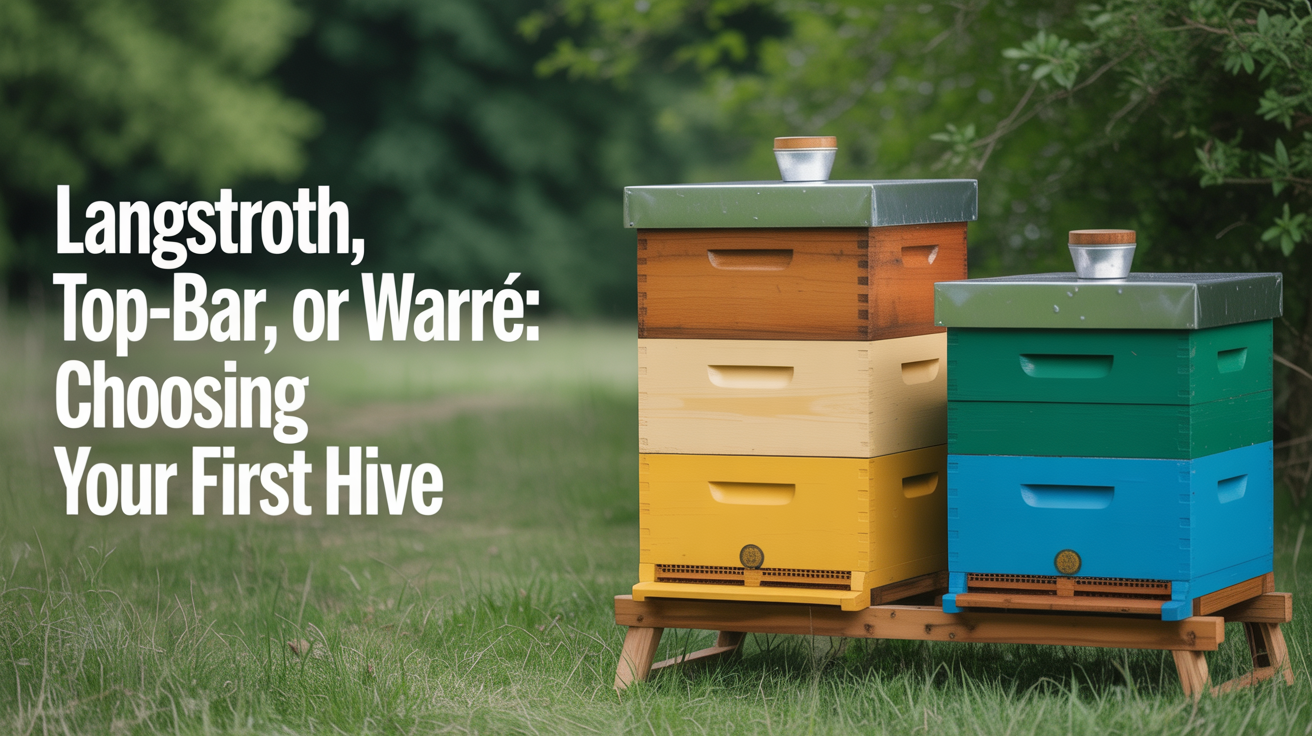
The hive style you start with will shape how you keep bees for years. Each of the three main designs reflects a different idea about what beekeeping should look like, and choosing the wrong one for your situation means fighting the equipment instead of learning the craft. Here is what actually matters when making that call as a first-year beekeeper.
What Each Hive Is Trying to Do
Before comparing specs, it helps to understand the philosophy behind each design, because the philosophy drives every design decision.
Langstroth
Moses Quinby and Lorenzo Lorraine Langstroth established the movable-frame hive in the 1850s around one key principle: maintain "bee space" (roughly 3/8 inch) throughout the hive so bees leave passages open rather than glueing components together with propolis. Every component, frames, boxes, lids, bottom boards, follows standardized dimensions. The hive is designed for the beekeeper's convenience as much as the bees' needs, making inspections fast and honey extraction straightforward.
Top-Bar Hive (Kenyan Top-Bar Hive)
The top-bar hive is a horizontal design. Bees build comb downward from removable bars laid across the top of a long, trough-shaped box. There are no frames, just the bar that the bees use as a starting guide. The design came out of low-cost beekeeping programs in Africa and suits hobbyists who want a gentler, less equipment-heavy approach and are not chasing maximum honey yield.
Warré Hive
Émile Warré published his design in 1948 as the "People's Hive," explicitly trying to mimic conditions inside a hollow tree. Boxes are stacked at the bottom (not the top) as the colony expands, and frames are replaced by bars similar to a top-bar hive. The theory is that bees in a Warré hive are less disturbed, build more natural comb, and overwinter well because they always have clean, newly-built comb below them. Inspections are minimal by design.
How Management Differs Across the Three
This is the clearest practical difference, and it matters more than aesthetics.
In a Langstroth, you open the hive regularly (every 7–14 days in spring and summer) to check for disease, monitor brood patterns, assess swarm preparations, and time honey harvests. You pull frames vertically out of boxes. It takes roughly 20–40 minutes per hive once you get the hang of it. The management cadence is active and data-rich.
In a top-bar hive, inspections happen less often, but they require more care. Comb is fragile because it has no surrounding frame for support. You slide bars horizontally, keep the hive level, and avoid twisting. Heavy honey comb will snap if you tilt it. Inspection rhythm is similar to Langstroth, but each inspection takes longer because fragile comb demands more patience.
In a Warré hive, the design philosophy actively discourages routine inspection. Warré himself recommended inspecting only when the bees give clear signals (excessive bearding, signs of disease). Many Warré keepers open the hive two or three times a year. That sounds appealing on paper, but for a beginner who has not yet learned to read bees, low inspection frequency means problems go undetected longer.
Parts Availability and Local Support
This is where Langstroth wins decisively in most of North America, Europe, and Australia.
Langstroth equipment is sold at every farm supply store, hundreds of online retailers, and beekeeping co-ops. Frames, foundation, boxes, feeders, queen excluders, all interchangeable between most manufacturers. If a box warps or a frame breaks mid-season, you replace it the same week. Your local beekeeping club almost certainly runs on Langstroth equipment, which means used gear is available cheap and mentors can inspect your hive without learning a foreign system.
Top-bar hives and Warré hives require ordering from specialty suppliers or building your own. Plans are freely available and the construction is not complicated, but it adds a project before you even have bees. Replacement parts are not at the hardware store. If you build non-standard dimensions (and many top-bar plans differ from each other), you cannot borrow or swap components with another beekeeper.
The Weight Problem
A fully loaded Langstroth deep super, 10 frames of honey, weighs about 80–90 pounds. Even a medium super (6 5/8 inch box) tops out around 50–60 pounds. Lifting boxes during inspections and harvest is the single most common reason experienced beekeepers switch hive styles in their 50s and 60s. If you have a bad back now, plan accordingly.
The standard workarounds in a Langstroth setup:
- Run mediums exclusively (a common decision; see hive box sizes for a longer look at this tradeoff)
- Use a hive stand that gets the hive off the ground so you are not bending
- Harvest more frequently to keep supers lighter
Top-bar hives eliminate the lifting problem almost entirely. You work one bar at a time, standing upright beside a waist-height hive. The heaviest lift is the lid.
Warré hives have a different physical challenge: adding boxes to the bottom of the stack requires lifting the entire upper colony off and setting it aside, then placing the new box underneath. With a colony in full swing, that is a two-person job or requires a specific lifting rig. Not back-strain free at all.
Honey Yield
Langstroth hives, managed actively, produce the most honey per colony. The standardized frame system makes running multiple supers easy, extraction equipment (radial extractors, uncapping planes) is designed around Langstroth frames, and the inspection cadence lets you catch problems that reduce yield.
Top-bar hives produce significantly less honey, for two reasons. First, the colony stays smaller because horizontal expansion has a fixed ceiling (the length of the box). Second, top-bar comb must be crushed and strained for extraction rather than spun, you cannot reuse it. Some hobbyists prefer crushed-comb honey anyway, but you are losing both volume and efficiency.
Warré hives fall somewhere in between when well managed, but because the design limits intervention, productivity is harder to optimize and varies a lot between keepers.
Comparison at a Glance
| Langstroth | Top-Bar (Kenyan) | Warré | |
|---|---|---|---|
| How it's managed | Active; frame inspections every 1–2 weeks | Moderate; careful bar inspections, fragile comb | Minimal by design; 2–3 inspections per year |
| Parts availability | Excellent everywhere | Specialty suppliers or DIY | Specialty suppliers or DIY |
| Lifting/back strain | High (80 lb full supers) | Low (bars only, waist height) | Medium-high (lift whole colony to add boxes) |
| Honey yield | High | Low–medium | Medium |
| Cost to start | $200–$350 assembled; $100–$180 DIY kit | $150–$300 or build from plans | $150–$300 or build from plans |
| Best for | Most beginners; anyone wanting mentorship or local club | Hobbyists prioritizing ergonomics over yield | Experienced keepers or low-intervention philosophy |
The Real Recommendation for Beginners
Start with a Langstroth. That is the honest answer for the majority of new beekeepers, and here is why it is not just the conventional wisdom talking.
Learning to read a hive takes time. You need to see brood patterns, watch how a healthy colony looks at different population stages, and develop an eye for queen cells, laying workers, and early disease signs. None of that happens without regular, confident inspections. The Langstroth frame makes inspection fast and repeatable. When you pull a frame and see something unexpected, you can compare it to photographs, describe it to your mentor, or bring a club member over to look, because they use the same equipment.
The local support network effect is real. Beekeeping clubs lend extractors, sell used supers, and mentor new beekeepers using Langstroth gear. Going into your first season with a top-bar or Warré hive means you are learning the hive style alongside the bees, without that peer layer.
The honest exceptions:
If back or joint problems make lifting 50+ pounds genuinely dangerous, a top-bar hive is a reasonable first choice, the ergonomic advantage is real. Just go in knowing your learning curve will be steeper and local support thinner.
If you have several years of beekeeping on Langstroth equipment and want to experiment, a Warré hive is an interesting project. It is not a good first hive.
If cost is the real constraint, building a top-bar hive from lumber scraps is cheaper than buying a Langstroth kit, and that legitimately tips the scales for some people.
Setting Up for Success Regardless of Hive Style
Whatever you choose, a few things apply across the board. Get a proper starter kit before your bees arrive. Learn to use a smoker correctly, calm bees make inspections possible regardless of hive design. Join your local beekeeping association even if their members run different equipment than you do; disease identification and swarm management knowledge transfers across hive types.
Place the hive where it gets morning sun and afternoon shade, faces away from foot traffic, and has a water source nearby. These basics matter more than the style of box.
Frequently Asked Questions
Which hive style is cheapest to start?
A DIY top-bar hive built from rough lumber costs the least upfront (under $75 in materials if you already have basic tools). A Warré hive built from plans runs similarly. A Langstroth starter kit from a catalog runs $180–$350 assembled, but used Langstroth equipment is common and cheap, check local clubs and estate sales before buying new.
Which hive is easiest on your back?
Top-bar hives, by a wide margin. You work one bar at a time at waist height with no heavy lifting. Langstroth hives loaded with honey require significant lifting. Warré hives require lifting an entire populated colony to add expansion boxes below, which is its own kind of demanding.
Can you mix hive styles in one apiary?
Yes, and many beekeepers do, Langstroth for productivity, one top-bar as a swarm catch or for low-intervention observation. The hives do not interact. The only complication is that frames and bars from different systems are not interchangeable, so you are maintaining separate tool sets and part inventories.
Which hive produces the most honey?
Langstroth, consistently, when actively managed. The combination of larger colony capacity, reusable drawn comb, and purpose-built extraction equipment makes it the most productive design in commercial and hobbyist contexts alike. Top-bar hives sacrifice yield for simplicity. Warré hives can produce well but require more experience to optimize.
Should I start with one hive or two?
Two, if you can afford it. The second hive gives you a comparison point. When something looks wrong in one hive (spotty brood, unusual population drop), a second hive tells you whether it is normal for this time of year or a real problem. Two hives also means you can move brood or resources between them if needed. Start two the same style so the comparison is clean.