Bee Health
Wax Moths: Protecting Comb and Weak Colonies
Learn how wax moths damage hives, which colonies are most at risk, and how to protect active hives and stored comb from infestations.
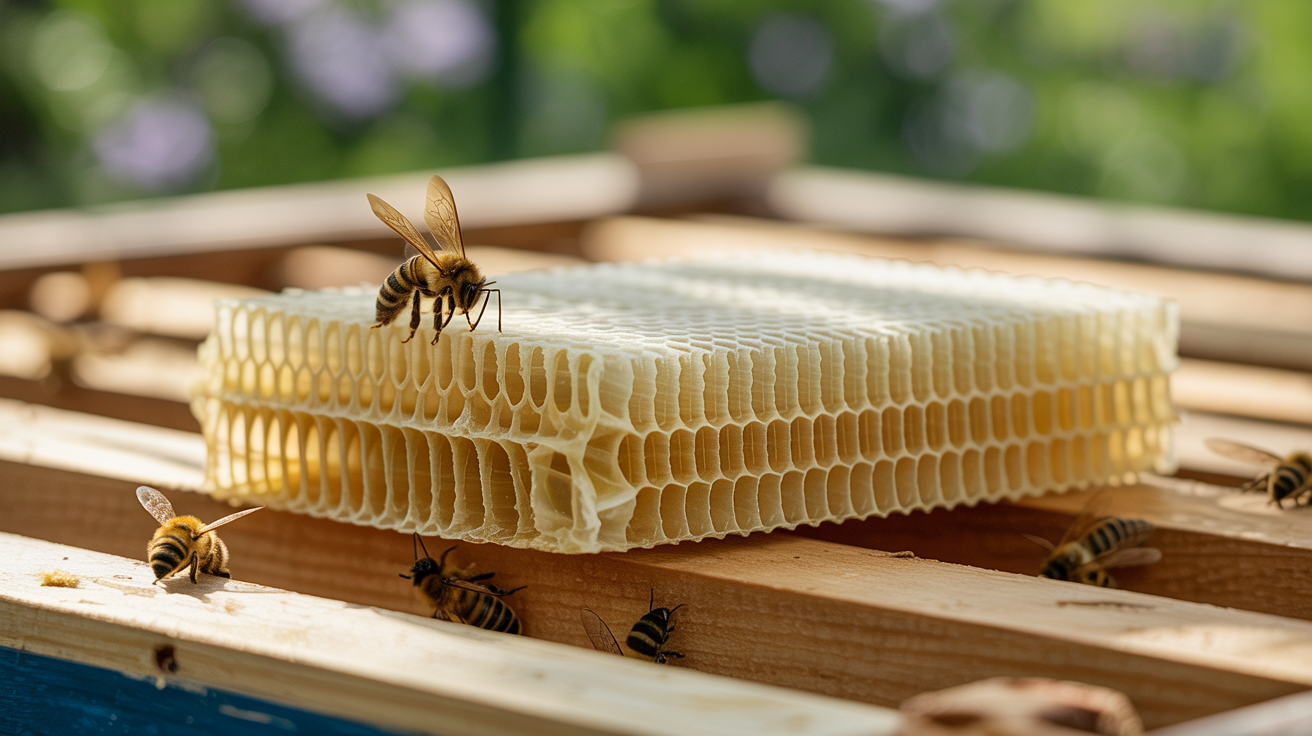
Wax moths are among the most common comb losses in backyard beekeeping, not because they attack strong colonies, but because they move fast whenever a hive is struggling or drawn comb is left unprotected.
What Wax Moths Are and How They Work
Two species cause problems for beekeepers: the greater wax moth (Galleria mellonella) and the lesser wax moth (Achroia grisella). The greater wax moth is the one most beekeepers encounter. It is a brownish-gray moth, roughly the size of a raisin, that lays eggs in cracks and crevices inside and around the hive. The larvae are the damaging stage. They burrow through comb, spinning silky tunnels as they eat wax, pollen residue, shed cocoon skins, and occasionally bee larvae.
Wax moths do not attack bees directly. They are scavengers that move into unguarded space. A healthy colony generates enough heat, has enough foragers and house bees, and patrols enough surface area to remove moth eggs and small larvae before they can establish. The problem starts when the bee population drops below a threshold where the bees can no longer cover their comb.
What Wax Moth Damage Looks Like
By the time most beginners spot it, wax moth damage is usually well advanced. Here is what to look for:
- Silky gray webbing or tunnels running along the face of comb or through the wooden midrib of a frame
- Frass (tiny brown pellets mixed with silk threads) on the bottom board or collected in the tunnels
- Sunken or chewed capping areas where larvae have bored into sealed brood cells
- Bare wooden frame bars in severe cases, with comb entirely consumed down to the foundation or wax foundation wires
- Creamy white larvae (roughly 18-20mm when full grown, with a brown head capsule) working through the mess
The webbing is the most reliable early sign. If you see it on a frame, pull the frame and look closely at the top bar and side bars. Larvae tend to burrow along the wood edges first, tracking the frame perimeter before moving into the comb body.
Wax moth damage can be misread. Tunneling through brood comb looks superficially similar to other problems. If you see scattered sunken cappings alongside silky webbing, that combination points to wax moths rather than American or European foulbrood, which presents without webbing and has distinct odor and appearance signatures of its own.
Which Colonies Are Most at Risk
Strong colonies with adequate bee populations are effectively immune during the active season. The moths are always present in your environment. You cannot eliminate them. What determines whether they cause damage is the ratio of bees to comb surface area.
| Situation | Why It Creates Risk |
|---|---|
| Colony going into winter in an oversized box | Bees cluster in one area and leave outer frames unguarded |
| Freshly split or combined colony | Low population, lots of open comb to cover |
| Hive weakened by varroa or disease | Bee numbers fall faster than the queen can replace them |
| Nucleus colony on full-size frames | Too much space for the population size |
| Stored extracted or drawn comb | No bees present at all |
The varroa connection matters a great deal. A colony whose mite load has climbed through late summer will lose adult bees faster than the queen can replace them. By September, the population may have dropped enough that the outer combs in the brood box become unguarded territory. If you find wax moth damage in an active hive, look carefully at whether mites drove the weakening first. Monitoring your mite levels before fall is one of the most reliable ways to prevent this chain reaction. An alcohol wash gives you an accurate mite count so you can treat before the colony contracts too far.
Preventing Wax Moths in Active Hives
The core principle is simple: keep the bee population matched to the box size.
Size the Box to the Bees
A second brood box left on a colony that has shrunk going into fall is a wax moth invitation. The bees will cluster in the lower box and leave the upper box entirely unguarded. If your colony is contracting, consolidate. Move frames the bees are actively covering to the center, push empty or pollen-only frames toward the outside edges, and consider removing the upper box entirely if the bees are not filling it.
Pull Supers Promptly After the Flow
Once the honey flow ends and you pull your supers, do not leave empty boxes on the hive. Extract and store the frames within a week if you can. Supers left on into late summer are warm, dark, and full of wax residue and that combination is exactly what a female moth is looking for.
Use an Entrance Reducer
A small entrance in late summer helps a colony guard more efficiently. A weakened hive has fewer bees to cover both the entrance and the comb. An entrance reducer costs almost nothing and takes 30 seconds to install.
Do Not Leave Frames Sitting Out
Wax moths can lay eggs on a frame left on the grass during an inspection. Keep frames in the hive or in a covered nuc box while you work. If you are doing splits or combining colonies and frames need to sit overnight, store them in a sealed bag or a tightly lidded frame box.
Protecting Stored Comb from Wax Moths
This is where most beginners lose drawn comb. Extracted frames, frames pulled from downsized hives, and drawn but unused frames are all vulnerable without bees to patrol them.
Freeze the Frames
Freezing is the most straightforward method for hobbyists. Place frames in heavy-duty garbage bags, press out excess air, and seal them. Freeze at or below -15°C (5°F) for at least 48 hours. This kills all life stages, including eggs, which are small enough to miss on visual inspection. Once frozen, keep the frames sealed until you return them to a hive.
Seal the bags while the frames are still cold after freezing. If you let them warm up first and then seal, condensation will form inside the bag and can encourage mold on pollen-heavy comb.
Store Cold
Wax moth larvae cannot survive extended periods below about 10°C (50°F). In areas with cold winters, an unheated garage or outbuilding is often sufficient from November through February. You still need to freeze or otherwise treat frames before cold storage, since eggs can hatch at low temperatures even if larvae cannot survive to the damaging stage.
Use PDB Crystals for Sealed Storage
Paradichlorobenzene (PDB) crystals are sold in beekeeping catalogs specifically for comb storage. They release vapors that are heavier than air, so the crystals must be placed above the frames in a sealed container, never below them. PDB works only while the container stays sealed and only while vapors are actively present. Before returning treated frames to a hive, air them out completely for several days; the residue will repel bees if you skip this step.
Two cautions: PDB crystals are not the same as standard naphthalene mothballs. Naphthalene is toxic to bees and should never be used for comb storage. Check the label before buying.
Return Clean Comb to a Strong Colony
If you have a strong colony with room to expand, clean drawn comb can be added to the outer edges of the brood nest or under a super. The bees will occupy it and keep it clear. This works well mid-season when colonies are strong; it is not a good strategy in late summer when populations are declining.
Frequently Asked Questions
Can wax moths actually kill a healthy colony? No. A colony with a full complement of bees will remove moth eggs and larvae before they can establish. Wax moths only cause serious comb damage when a colony is already weakened or comb is stored without bees. If moths apparently destroyed a colony, something else weakened it first, and varroa is the most common culprit.
My hive has wax moth larvae in it. What do I do now? Remove and inspect the affected frames. Frames with light surface webbing and otherwise intact comb can sometimes be cleaned and returned if the colony is strong enough to recover them. Heavily tunneled frames with little usable comb left are usually not worth saving. Scrape them clean down to the foundation and let the bees rebuild. Do not return frames with live larvae; shake off any pupae and let the bees handle any cocoons themselves.
Is there a spray or treatment I can apply to prevent wax moths in the hive? No. There is no approved chemical treatment for wax moths inside a live colony. Prevention is entirely a management question: right-sized boxes, prompt extraction, and matched population-to-space ratios. For stored comb, PDB crystals and freezing are the two practical options for most hobbyists.
I froze my frames last year but they still got moths. What went wrong? Either the bags had a small gap that let moths in after freezing, the frames were not fully frozen through before bagging, or condensation inside an improperly sealed bag allowed a re-entry point. Thick frames with propolis-sealed edges can insulate the core and prevent a full freeze. Seal bags while frames are still cold, tape any seams, and store them off the floor where rodents cannot chew a hole in the bag.
Are wax moths only a problem in warm climates? They are more active in warm climates but occur across most of North America, Europe, and Australia wherever honeybees are kept. Cold winters suppress moth populations, which is why stored comb in unheated northern garages often survives without treatment. Beekeepers in warmer regions with mild winters need to be more deliberate about storage protection year-round.