Colony Life
Inside the Hive: Queen, Workers, and Drones Explained
Meet the three castes that make a bee colony work: the queen, workers, and drones. Learn their roles, lifespans, and why each one matters.
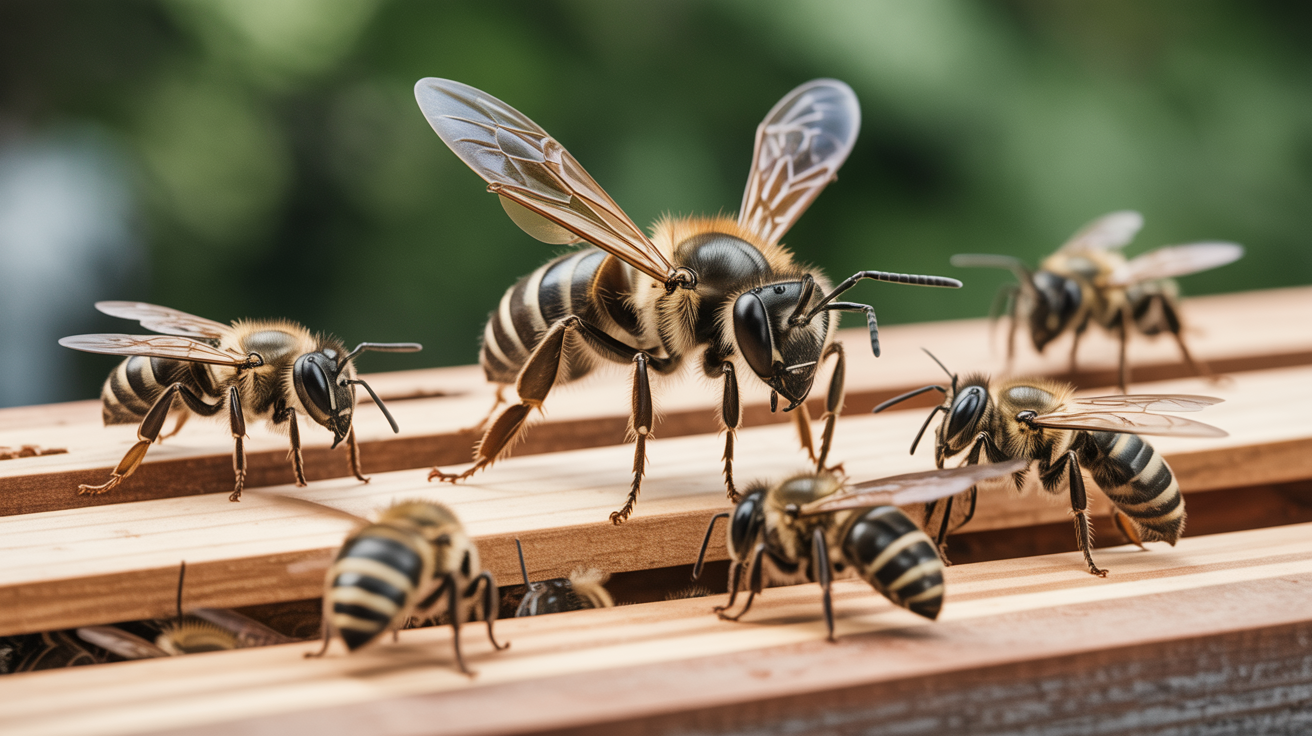
A honey bee colony isn't a crowd of individual insects doing their own thing. It functions more like a single organism, with each bee playing a role that serves the whole rather than itself. Three distinct castes make this possible: the queen, the workers, and the drones. Understanding what each one does, and why, changes how you read a hive when you pull a frame.
At a Glance
- A colony has exactly one queen, tens of thousands of workers, and a seasonal population of drones that swells in spring and disappears by fall.
- The queen doesn't direct colony behavior; her influence comes almost entirely from pheromones, not commands.
- Workers move through a predictable sequence of jobs by age: cleaner, nurse, builder, guard, then forager.
- Drones exist for one purpose, mating with virgin queens, and are evicted from the hive before winter because they consume stores without contributing to survival.
- A queen mates with roughly 10-20 drones during a handful of flights early in her life and stores that sperm for the rest of her laying career.
- Reading brood pattern, cell shape, and caste ratios on a frame tells you far more about colony health than counting bees.
The Three Castes at a Glance
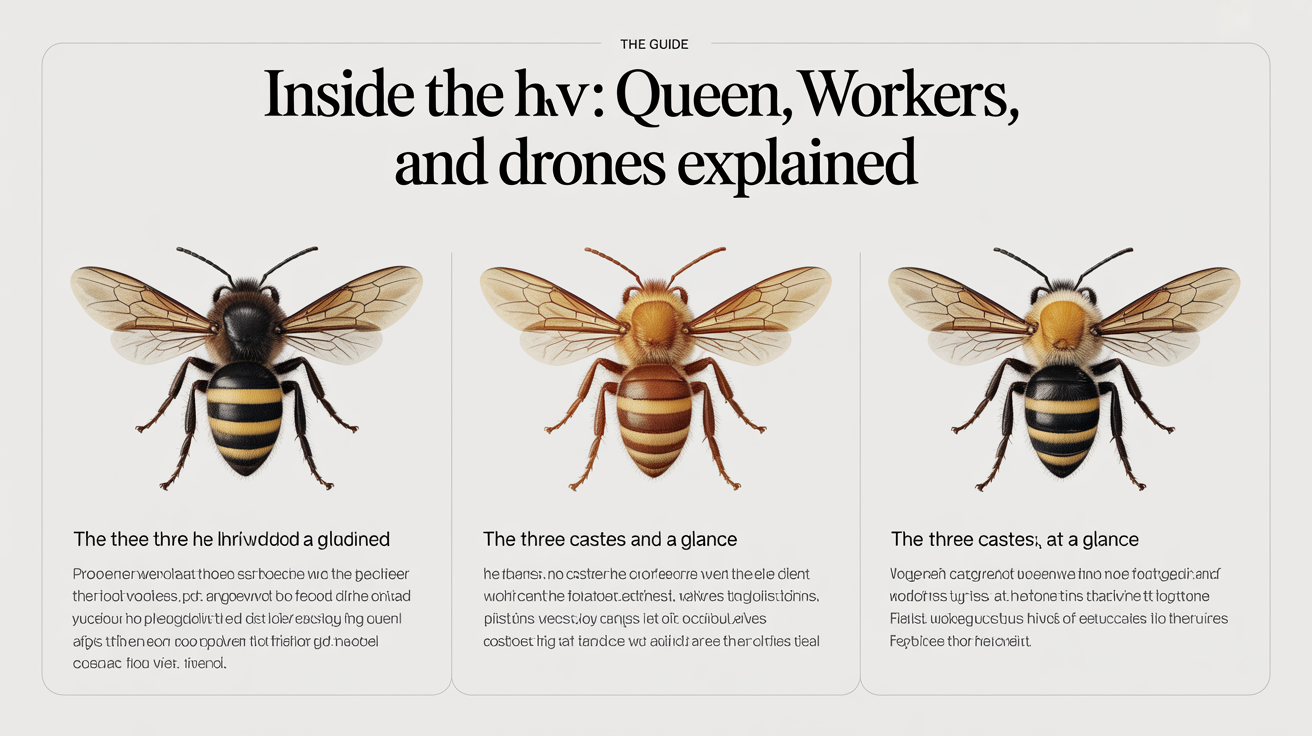
Before diving into each caste individually, here's a side-by-side comparison. The numbers are approximate and shift by season and colony strength.
| Queen | Worker | Drone | |
|---|---|---|---|
| Sex | Female | Female | Male |
| Number in colony | 1 | 20,000-60,000 | 0-2,000 (seasonal) |
| Lifespan | 2-5 years | 6 weeks (summer); 4-6 months (winter) | 8-12 weeks (evicted before winter) |
| Main jobs | Lay eggs; produce pheromones | Build comb, nurse brood, guard, forage, and much more | Mate with virgin queens |
| Time from egg to adult | 16 days | 21 days | 24 days |
The development timeline matters in practice. If you see capped cells taking longer than expected to emerge, it's a useful clue about what type of brood you're looking at.
The Queen: Her Real Job (and What She Doesn't Do)
There's a common misconception that the queen "runs" the colony. She doesn't direct or command anything. Her job is almost entirely reproductive. A laying queen can deposit 1,500 to 2,000 eggs per day at peak season, more than her own body weight in eggs over the course of a week. That single output sustains the entire population.
Pheromones: The Queen's Real Influence
What does shape colony behavior is her chemical signature. Queen mandibular pheromone (QMP) suppresses the development of ovaries in worker bees and prevents them from raising new queens while a healthy queen is present. Workers constantly groom and feed the queen and then spread her pheromones through the colony by touch. If that signal weakens, whether because the queen is failing, injured, or dead, workers respond within hours by beginning to build emergency queen cells.
A strong, well-mated queen produces a consistent, detectable pheromone profile. When beekeepers talk about a queen "being accepted" by a new colony, they're really talking about this chemical recognition. The University of Florida's IFAS Extension covers this pheromone-driven social structure in detail in its publication on honey bee castes, which is a good next step if you want the underlying biology behind what beekeepers observe in the field.
Mating and the Spermatheca
A queen mates only during a brief window early in her life, typically over several flights within her first one to two weeks, visiting drone congregation areas where she mates with roughly 10 to 20 drones in the air. She stores that sperm for the rest of her laying life in a specialized organ called the spermatheca and never mates again. Texas A&M AgriLife researchers are actively studying how environmental stress during this narrow mating window affects long-term colony health, since the quality and viability of what she stores determines how long she can sustain the colony. A queen that mated poorly, whether from bad weather, a thin local drone population, or other stress, often shows it months later as a spotty brood pattern or an early supersedure.
Lifespan and Replacement
A queen can live two to five years, but her egg-laying capacity declines after year two. Experienced beekeepers often replace queens in their second or third year to maintain colony strength. The colony itself will also supersede (replace) a failing queen when her pheromone output drops. You'll see this as a quiet, unannounced queen-cell construction alongside the existing queen, without the drama of a swarm.
The Worker: The Engine of the Colony
Workers are all female and represent nearly every bee you'll see inside the hive or flying outside it. Their lives are structured around a predictable progression of tasks tied to age. This isn't rigid, but it's consistent enough that you can roughly gauge a worker's age by what she's doing.
Age-Based Job Progression
- Days 1-3 (Cleaner): A newly emerged worker spends her first days cleaning out the cell she hatched from and polishing other cells so the queen can lay in them again.
- Days 3-12 (Nurse bee): Workers develop functional hypopharyngeal glands during this stage, which produce the royal jelly fed to young larvae. Nurse bees spend most of their time visiting cells, assessing larvae, and adjusting feeding. A single larva may be checked and fed well over a thousand times before it's capped.
- Days 12-18 (Wax producer / comb builder): Wax glands on the underside of the abdomen reach peak function. Workers produce beeswax scales and use them to build or cap comb. They also receive nectar from incoming foragers and begin ripening it. Building a pound of comb costs the colony roughly eight pounds of honey in wax-gland energy, which is part of why beekeepers protect drawn comb so carefully at harvest time.
- Days 14-18 (Guard): Guards station themselves at the hive entrance, checking incoming bees by scent. A guard can sting to defend the colony and dies in doing so if the stinger lodges in skin (it's barbed and tears free, pulling abdominal tissue with it).
- Days 21+ (Forager): Once a worker's internal glands begin to decline, she transitions to field work. Foragers collect nectar, pollen, water, and propolis. A forager may make a dozen or more trips per day and cover several miles. She'll die in the field, usually from exhaustion, predation, or simple wear after three to four weeks of foraging.
This age-based system has real resilience built in. If a colony loses a large portion of its forager force (a common effect of pesticide exposure), young nurses can accelerate their development and take on foraging earlier than typical. The colony self-corrects.
Learn more about the honey bee life cycle to see how workers, queens, and drones each follow a distinct developmental path from egg to adult.
The Drone: Built for One Purpose
Drones are male bees, and they can't sting (they have no stinger). They don't forage, don't produce wax, don't nurse brood, and don't guard the hive. They exist to mate with virgin queens.
Drone Flight and Mating
Drones gather in specific outdoor locations called drone congregation areas (DCAs), typically 30 to 100 feet off the ground, often in the same spots year after year. Virgin queens fly to these areas, and mating occurs in flight. A queen mates with 10 to 20 drones during her mating flights and stores the sperm in a specialized organ called the spermatheca. She'll use this stored sperm for the rest of her laying life, never needing to mate again.
Drones that succeed in mating die immediately. Those that don't return to the hive, eat honey, and try again. From the colony's perspective, drones are an investment in genetic diversity and the potential to father queens in other colonies.
Why Drones Are Evicted Before Winter
A colony can't afford to feed non-productive bees through the winter. As nectar flow slows in late summer, workers begin blocking drones from accessing food stores. Over a period of weeks, drones are physically driven to the entrance and pushed out. They can't regulate their body temperature well enough to survive outside and typically die within a day. By October in most temperate climates, a healthy colony is completely droneless.
If you open a hive in late fall and find drones still present, it can indicate a queenless or laying-worker colony. A colony without a laying queen has no reason to evict drones, since it may still need them.
How the Three Castes Form a Working Colony
The queen handles reproduction. The workers do everything else the colony needs to survive. The drones handle the colony's genetic future. Each caste depends on the others.
Workers can't reproduce under normal conditions (the queen's pheromones suppress it). The queen can't feed herself (workers do it). Drones can't even get water on their own. This mutual dependence is why the colony behaves as an organism rather than a population.
The ratio of each caste shifts throughout the year. Spring sees a rapid buildup of workers and the production of drones as the colony prepares for swarm season. See why bees swarm for how caste dynamics drive that behavior. Summer is peak population. Fall is a gradual contraction, drone eviction, and preparation for winter cluster formation.
A Rough Seasonal Snapshot
None of these numbers are fixed, but they give you a sense of scale as a colony moves through the year. A hive coming out of winter might hold as few as 10,000 to 15,000 workers and zero drones. By early summer, a strong colony can climb past 50,000 workers with 500 to 1,500 drones present. By late fall, worker numbers taper back down toward 20,000 to 30,000 as the colony sheds foragers it no longer needs and drones disappear entirely. Watching that arc across a full season, rather than judging a single inspection in isolation, is one of the better habits a second-year beekeeper can build.
Reading a Frame with Caste Knowledge
When you pull a frame during an inspection, you're reading the colony's health through the lens of what you know about each caste.
A solid, consistent brood pattern (few empty cells, consistent capping height) points to a productive queen. Scattered or "shotgun" brood can indicate a failing queen, disease, or laying workers. Seeing multiple eggs per cell is a strong sign of laying workers rather than a queen, since laying workers can't control egg placement the way a mated queen can.
Capped cells on the outer edge of a frame with a concave, papery cap are drone cells. They're noticeably taller than worker cells. The 24-day development period for drones means you can roughly time the emergence of new drones after spotting freshly capped drone brood.
Finding a queen cell (large, peanut-shaped, often hanging off the bottom or edge of a frame) tells you the colony is preparing to swarm, replace its queen, or doing an emergency supersedure. The location and condition of the cell give you more information: smooth and fully capped usually means it's progressing; torn open from the side can mean a beekeeper (or another queen) already got there.
Understanding how bees make honey connects caste knowledge directly to what you see in the honey super, since the forager-to-house-bee handoff is a key step in nectar ripening.
Frequently Asked Questions
Do workers ever lay eggs?
Yes, but only under specific conditions. Workers retain undeveloped ovaries. When a colony loses its queen and goes long enough without being able to produce a new one (no young larvae to raise queen cells from), some workers' ovaries activate and they begin laying unfertilized eggs. Since workers can't mate, these eggs can only develop into drones. A laying-worker colony produces no workers, shrinks steadily, and will eventually die without intervention. It's one of the more difficult colony conditions to correct.
Can a colony make a new queen on its own?
Yes, provided the colony has worker-aged larvae three days old or younger. Workers can redirect any of these larvae into a queen cell by feeding them exclusively royal jelly and building a larger cell around them. The key window is tight: larvae older than about 72 hours have already been committed to worker development and can't become functional queens. If a colony loses its queen and has no young enough larvae, it can't self-rescue.
Why do bees kick out drones in the fall?
Drones consume significant stores of honey without contributing to winter survival. As the colony prepares to cluster for winter, maintaining non-essential bees becomes a liability. Workers physically evict drones and block them from re-entering. The behavior is triggered by declining nectar availability and shortening day length rather than a single temperature threshold. A colony that keeps drones through winter is almost always queenless.
How long does a queen actually live?
Most queens live two to five years under good conditions, but productive lifespan is shorter. Egg-laying output typically peaks in the first two years and declines after that. Many beekeepers requeen proactively every one to two years to maintain strong populations. A queen that's failing (sparse brood pattern, missing eggs, poor pheromone output) will often be superseded by the colony before she dies, so the queen you find in a well-managed hive may be younger than the hive itself.
Do drones have fathers?
Not in the usual sense. Drones develop from unfertilized eggs through a process called haplodiploidy, so they have a mother (the queen) but no father, and they carry only one set of chromosomes instead of two. This is also why drones can't pass on any traits from a father, every gene a drone carries comes from the queen alone. It's one of the more counterintuitive facts of bee genetics and it affects breeding decisions for anyone raising queens.
How many drones does a healthy colony produce in a season?
A strong colony typically raises a few hundred to around 2,000 drones at the height of spring buildup, though the number varies with colony strength, comb availability, and local drone-rearing conditions. Colonies with mostly foundation comb (which biases cell size toward worker cells) tend to produce fewer drones than colonies with some foundationless or well-aged comb, where bees build more of the larger drone cells on their own.