Honey & Harvest
When Is Honey Ready to Harvest? Reading Capped Frames
Honey is ready when frames are 80%+ capped and moisture is under 18.5%. Learn to read capped frames, test moisture, and harvest at the right time.
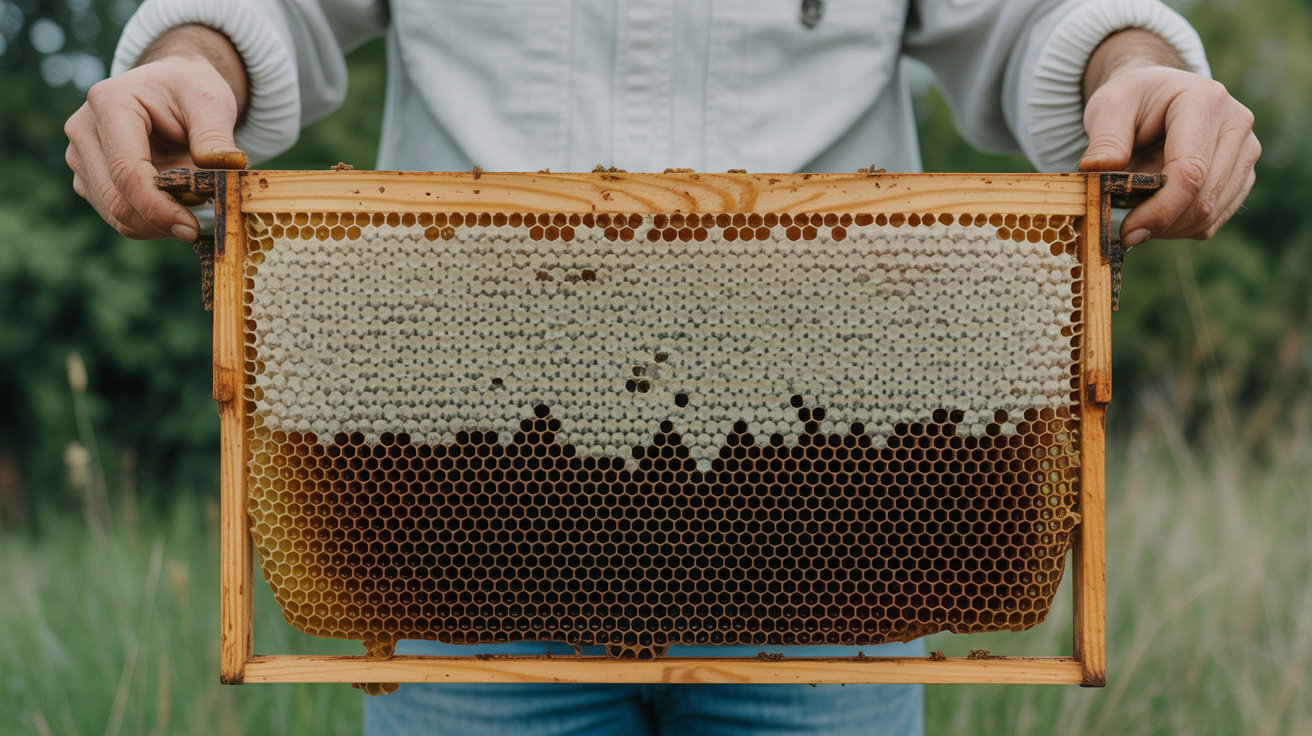
Honey is ready to harvest when it's ripe, and ripeness has nothing to do with the calendar. It comes down to two things: the moisture content of the honey and whether the bees have sealed the cells with wax. Get both of those right and your honey will keep for years. Miss either one and you risk a jar of fermented, yeasty liquid that no one wants.
At a Glance
- Harvest frames that are at least 80 percent capped; that's the industry-standard shortcut, not a hard guarantee.
- Target moisture under 18.5 percent. Above 20 percent, fermentation is likely.
- The shake test (invert and shake a frame; nothing should drip) catches obviously unripe honey for free, in seconds.
- A $30 to $60 refractometer gives you an exact moisture reading and removes the guesswork, especially in humid climates.
- First-year hives often produce little or no harvestable surplus; don't take honey the colony needs for winter.
- Colonies in most of the northern US and Canada need 60 to 80 pounds of honey in storage to survive winter, roughly two deep supers.
Why Moisture Content Matters So Much
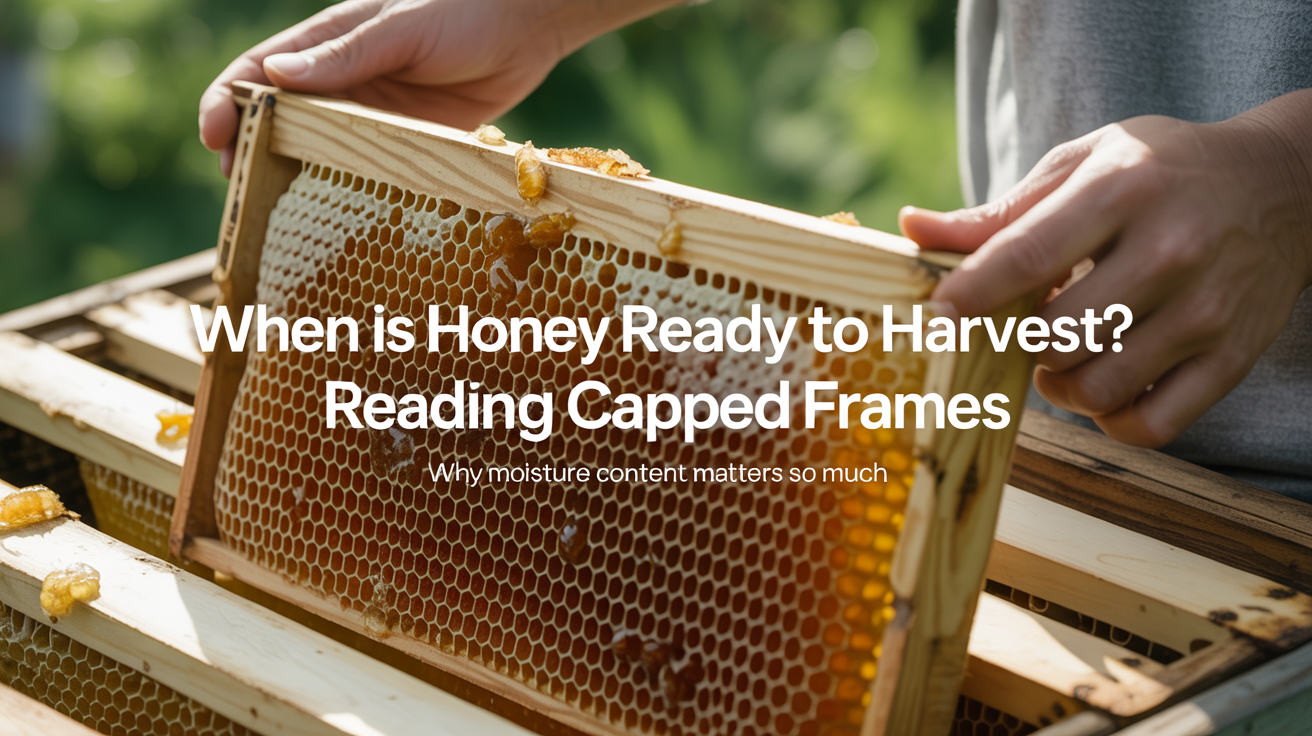
Fresh nectar is mostly water, somewhere between 60 and 80 percent. Bees convert that into honey by evaporating it down, fanning their wings over the open cells until the moisture level drops below about 18 to 19 percent. At that point, the natural sugar concentration is high enough to prevent fermentation. The bees know it's done when they cap the cells with a thin layer of white or pale yellow beeswax.
If you harvest before they've finished that job, you end up with what beekeepers call "green" or unripe honey. Green honey ferments. Yeasts that are harmless in ripe honey become active when there's enough water present, and the result smells like bread dough or beer. Depending on your moisture level, fermentation can start in weeks or months. Either way, it's a problem you can avoid entirely by waiting.
This is worth saying plainly: uncapped honey is not necessarily bad honey, but you don't know its moisture level without testing it, and a lot of it will be too wet to store safely. Capping is the bees' signal that the job is done.
The 80 Percent Capping Rule
The standard guidance you'll hear from most beekeepers is to harvest frames that are at least 80 percent capped. That means roughly four out of five cells are sealed with wax before you pull the frame.
There's some flexibility here. A frame that's 75 percent capped, in a warm dry summer, may have honey that's perfectly ripe. A frame that's 85 percent capped in a cool wet season could still have high-moisture honey in those uncapped cells. The capping rule is a reliable shortcut, not a guarantee.
What you're looking for when you inspect a frame:
- Flat or slightly indented white or light tan wax caps covering most cells
- No wet, shiny, open cells with liquid visibly present
- The frame feels heavy relative to its size
- The capped surface is even with no large patches of uncapped cells in the middle of the frame
- A dry, slightly papery look to the caps (wet cappings, which look darker, are fine too and are normal in some honey types)
If you're seeing large sections of open cells with liquid nectar that hasn't been processed yet, put the frame back and check again in a week or two.
Honey shows like the ones judged under the Welsh Judging Method, a scoring system used by Texas A&M AgriLife Extension and adopted at fairs around the country, treat moisture the same way home beekeepers should: thick, slow-streaming honey passes; anything that streams thin or smells fermented is disqualified outright, and any entry measuring 18 percent moisture or higher is automatically disqualified regardless of how it looks.
The Shake Test
Before you pull frames, do a quick shake test. Hold the frame horizontally over the hive and give it a sharp downward shake. If drops of nectar or thin liquid fly out, the honey in those cells isn't ripe yet. Ripe honey is thick enough that it stays in place even when the frame is inverted. Nothing should come out.
The shake test is free, takes two seconds, and catches obvious cases of unripe honey. It won't tell you the moisture percentage, but it will stop you from pulling obviously green frames by mistake.
One note: even a mostly capped frame can have a few open cells toward the edges that pass the shake test fine. You're looking for a general sense of whether liquid is flying out, not chasing down individual cells.
Measuring Moisture with a Refractometer
If you want a precise reading, use a refractometer. A honey refractometer costs $30 to $60 and will last years. You put a small drop of honey on the glass, close the cover plate, hold it up to light, and read the scale. The boundary between the dark and light areas shows you the moisture percentage (sometimes called Brix or water content, depending on the scale).
Here's what the numbers mean:
| Moisture % | What It Means |
|---|---|
| Under 18.5% | Ideal. Shelf-stable, won't ferment. |
| 18.5–20% | Use reasonably soon. Some risk of fermentation over time, especially in warm storage. |
| Over 20% | Will likely ferment. Not suitable for long-term storage. |
Target under 18.5 percent whenever possible. USDA's grade standards for extracted honey define moisture as a core quality attribute and specify measuring it with a refractometer, exactly the tool and method described above. Some beekeepers aim for under 18 percent to give themselves extra margin.
To get a reading, extract a small sample from an uncapped cell or scrape a tiny bit of honey from a capped cell. Test a few cells from different parts of the frame. Moisture can vary slightly across a frame, so a few readings give you a better picture than one.
If you don't have a refractometer yet, the capping rule plus the shake test will get you through your first harvest without major problems. But once you're running multiple hives or selling honey, a refractometer is worth having.
Quick Reference: Is This Frame Ready?
| Capped % | Shake Test | Refractometer (if available) | Verdict |
|---|---|---|---|
| 80%+ | Dry, nothing drips | Under 18.5% | Harvest |
| 80%+ | Dry, nothing drips | No reading taken | Harvest; capping and shake test agree |
| 60–79% | Passes, but marginal | 18.5–20% | Wait one to two weeks, retest |
| Under 60% | Liquid flies out | Not tested | Return to hive; check again later |
| 80%+ but frame feels light | Passes | Over 20% | Wait; capping alone was misleading here |
Timing Within Your Season
Honey harvest timing varies by region and by what's blooming. Most beekeepers in temperate climates harvest once or twice a year, typically after the main nectar flow ends. That might be early summer after spring wildflowers, or late summer after clover, basswood, or goldenrod.
The general pattern: nectar flows in, bees process and cap it, you harvest. The tricky part is that the flow and the capping don't always line up neatly. A strong flow can fill supers faster than bees can cap, so you might have full frames that aren't ready yet. Don't rush it.
A few timing pointers:
- Watch for the flow to slow or stop. When the bees are no longer bringing in heavy loads of nectar, they'll finish capping what's in the hive.
- In areas with a fall flow (goldenrod, aster), be careful about harvesting late summer honey before the fall bees have finished it.
- Pull honey supers before cold weather sets in. Honey left on the hive through winter is harder to extract and the bees will consume some of it.
One thing that should not need saying but does: never harvest honey from frames that contain brood. If you see capped cells that look darker, more uniform in color, and slightly convex, those may be capped brood, not capped honey. Brood cells are usually found on the lower frames in the brood nest, but if bees are crowded, brood can get into supers. Never put a brood frame through an extractor.
First-Year Hives vs. Established Colonies
If you started your hive this year, be realistic about surplus honey. A package or nuc installed in spring spends most of its first season building comb, raising bees, and establishing itself. Many first-year hives produce little to no surplus in their first summer.
Pulling honey from a first-year hive that hasn't built up enough stores is one of the most common ways new beekeepers set their colonies up for winter starvation. The bees need enough honey to make it through winter (see how much honey to leave bees for winter), and a young colony may not have much beyond that.
If your first-year hive has added a super and the bees are capping it, that's a good sign. You may be able to take a small harvest. But if the super is half-drawn and mostly uncapped going into late summer, leave it. Your bees will need it more than you do.
Established colonies, by contrast, often cap multiple supers in a good flow year. With several boxes of capped honey, you can harvest a few supers and still leave the bees well provisioned.
A worked example helps put this in perspective. A fully capped medium frame holds roughly 3 to 4 pounds of honey, so a 10-frame medium super with 8 usable frames capped is around 25 to 30 pounds. An established double-brood hive that fills two supers in a strong flow can reasonably yield 50 to 60 pounds of surplus, well above the 60 to 80 pounds the colony itself needs, so both the bees and the beekeeper come out ahead. A first-year hive that fills half of one super, by contrast, is producing 12 to 15 pounds, which is closer to what the bees will want back over winter than to a harvestable surplus.
Leaving Enough for the Bees
A harvest that takes too much is worse than no harvest at all. Bees that go into winter without adequate stores will starve, and feeding sugar syrup in late fall is a poor substitute for real honey.
Before you pull supers, know what the bees need. In most of the northern US and Canada, a colony needs 60 to 80 pounds of honey to make it through winter. That's roughly two deep supers or equivalent. Southern beekeepers can often get by with less.
After your harvest, inspect the brood boxes. If the frames are well covered with capped honey above and beside the brood, you're in good shape. If the frames look sparse, hold off and let the bees keep what's in the supers, or plan on supplemental feeding.
The goal every year is to take your share without putting the bees at risk. A colony that survives winter and thrives the following spring is worth more to your operation than a few extra pounds of honey taken at the wrong time.
After Harvest: Extracting and Storing
Once you pull capped frames, extract promptly. Honey left sitting in frames at room temperature can absorb moisture from the air, especially in humid climates. If you're using a centrifugal extractor, check out the full walkthrough in how to extract honey at home step by step. If you're working with small quantities or irregular comb, the crush and strain vs extractor comparison can help you pick the right method.
Store extracted honey in sealed glass or food-grade plastic at room temperature, away from sunlight. Properly ripe honey doesn't need refrigeration and will keep indefinitely if moisture is below 18.5 percent. A fermented odor after storage, described in judging guides as smelling like bread dough or beer, is the clearest sign the moisture was too high at harvest and the batch should be used soon rather than stored long-term.
Frequently Asked Questions
Do I really need a refractometer, or can I just go by capping?
You don't need one for your first harvest. The 80 percent capping rule plus the shake test is a reasonable approach, and most honey capped by bees in a dry season will be under 18.5 percent moisture. That said, a refractometer removes the guesswork, particularly in wet climates or in years with heavy rain during the flow. If you plan to sell honey, a refractometer is more or less required, since fermented honey damages your reputation and potentially your customers' goods.
What if only some frames in a super are fully capped?
Pull the capped ones and leave the rest. You don't have to harvest an entire super at once. Remove the frames that meet the 80 percent threshold, extract them, and return the uncapped frames so the bees can finish. Mark the box so you remember it still has unfinished frames. Check again in one to two weeks.
Will my first-year hive make surplus honey I can harvest?
Maybe, but don't count on it. Some first-year hives in a strong nectar year do produce a harvestable surplus, particularly packages installed early and in areas with good forage. Others produce just enough for themselves. The honest answer is that you won't know until late summer. Check the supers, check what's in the brood boxes, and make the decision based on what you actually see, not on hope.
Can you harvest honey too late in the season?
Yes. Leaving honey on the hive too long in fall has a couple of downsides. The bees will start consuming it as the flow ends and temperatures drop. It also becomes harder to extract once it cools and thickens. And in some climates, a late-season cold snap can make the frames brittle and difficult to work with. Aim to harvest before temperatures consistently drop below 50°F (10°C) at night.
My refractometer reading seems off. What am I doing wrong?
The two most common errors are temperature and technique. Refractometers are calibrated for a specific temperature, usually 68°F (20°C); a reading taken on a hot summer afternoon straight off the extractor can be off by a percentage point or more unless your unit has automatic temperature compensation. The other common mistake is testing honey with air bubbles or crystals in the sample, which skews the light refraction. Let the sample settle, wipe the glass clean between readings, and test two or three spots on the same frame before trusting a single number.